Ecesis — The News Journal of SERCAL
Ecesis is like a mini-conference delivered directly to California's restoration community! And BONUS! We're highlighting articles in social media. We are soliciting thought-provoking articles from colleagues, from interesting presentations we’ve heard, from people who are on the front lines of the latest trends.
Did you know you have an open invitation to send in an article? We are looking to plan ahead as much as two years in advance. Check out our guidelines. We are soliciting articles from YOU, your colleagues, from interesting presentations we’ve heard, from people who are on the front lines of the latest trends.
In 2026, we are moving to publishing two gloriously packed issues a year, one post-conference and one at year’s end. Ecesis continues to be a top priority, but twice a year — for now — seems to be the most realistic schedule, given that the conference has significantly expanded its scope.
Below are volumes published since 2013; please contact julie@sercal.org for an earlier issue. Not a member? It's easy to join and you'll also receive discounts to our conferences, workshops and other events.
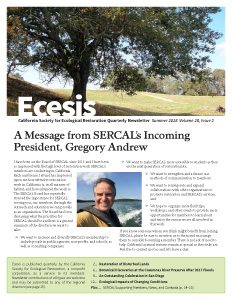
Summer 2026: The Social Dynamics of Restoration aka SERCAL 2026 Recap
Enjoy, Enjoy!
Here is a link to the full issue! OR you can browse via the images or the excerpts below.
A LETTER FROM THE EDITOR “Restoration success is often defined by achieving outcomes linked to quantifiable metrics that align with pre-determined objectives. We rely on the clarity of project goals, careful alignment of restoration interventions, and consistent monitoring of responses to ensure that restoration efforts have the highest potential for success. Yet, checking metrics off our list is not the only reason to engage in restoration. Restoration is a socioecological process that can empower communities and build resilience through direct and iterative action. When we restore ecosystems, we also restore our relationship to the environment and each other..."
REFLECTIONS ON THE SERCAL 2026 CONFERENCE “From May 18 to 20, SERCAL gathered on the North Coast for the first time in the organization’s history. This was new terrain for us in more than one sense! At long last, our Northern California colleagues had the opportunity to welcome us into the work and community they have built over the last three-plus decades. With the active participation of key Indigenous land stewards, we are hopeful that we have begun creating a mutually beneficial meeting ground for future conversations about centering Indigenous leadership in restoration.
Our conference theme, “Adaptive by Nature: Restoring in an Era of Uncertainty” — reflects the shifting political landscape and the very real questions it raises for the future of ecosystem conservation in California. In a moment when the ground under our field keeps moving, adaptability is not an abstraction. It is the work itself."
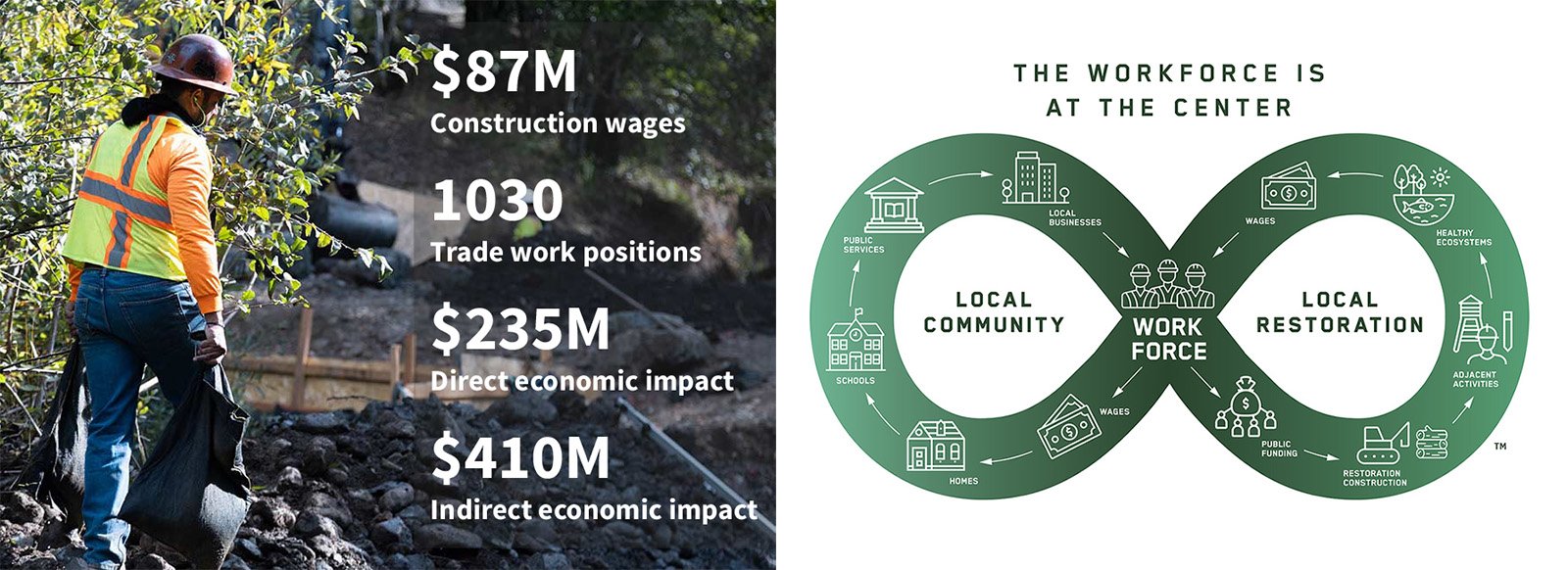
FEATURE — Ecology = Economy — The Workers Are at the Center of Ecological and Economic Uplift When we talk about restoration projects, we usually talk about the benefits to species and habitats — the salmon returning to a creek, the floodplain reconnected, the redwood forest floor opening up to sunlight after decades of overcrowding. We may talk about ecosystem services, carbon sequestration, climate resilience. These are all noteworthy outcomes, and they matter enormously.
But we rarely talk about the number of jobs these projects create. Or the wages those jobs pay, or what it means for a family in Del Norte County — where people have been leaving for years in search of work — when a multi-year restoration project comes to their community and brings prevailing-wage trade jobs with it.
The truth is that the first species to benefit from a restoration project are humans — in particular, the workers who build it.
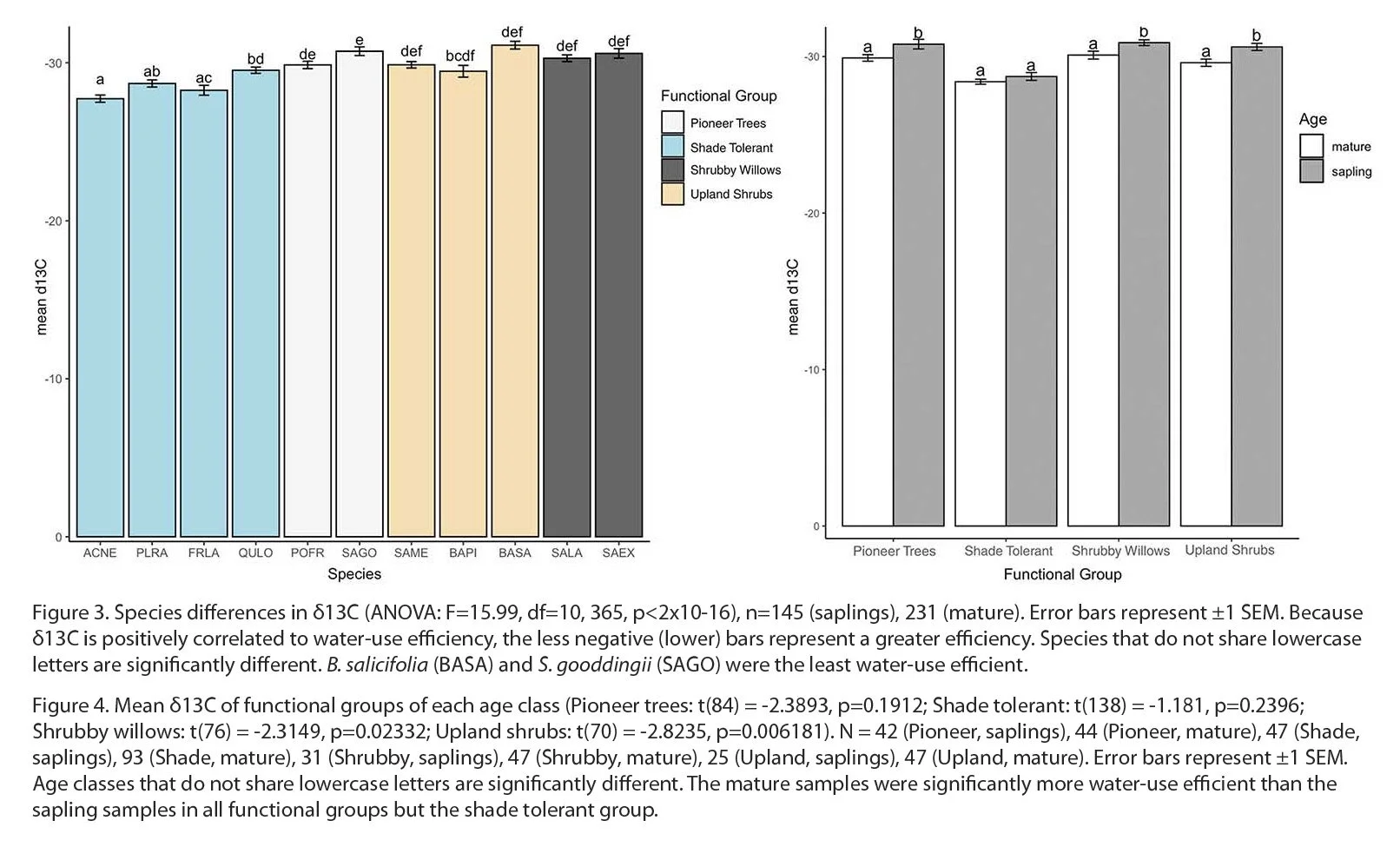
FEATURE — The Value of Shade-Tolerant Woody Species for Riparian Restoration in California: An Isotopic Water-Use Efficiency (δ13C) Approach Riparian forests in California are important for their intrinsic value, water quality maintenance, and flood-prevention services (National Resource Council 2002). However, 95% percent of riparian habitat in California’s Central Valley has been lost due to human activities (Katibah 1984). A variety of nonprofit, state, and federal organizations have contributed to wide-scale restoration investments along the Sacramento River including via the California Federal Bay-Delta Program (CALFED) Ecosystem Restoration Program (Golet et al 2013). More action is needed to restore the roughly 308,750 hectares of riparian habitat once present along the river, which has been lost due to conversion into farmland (Golet et al 2013).
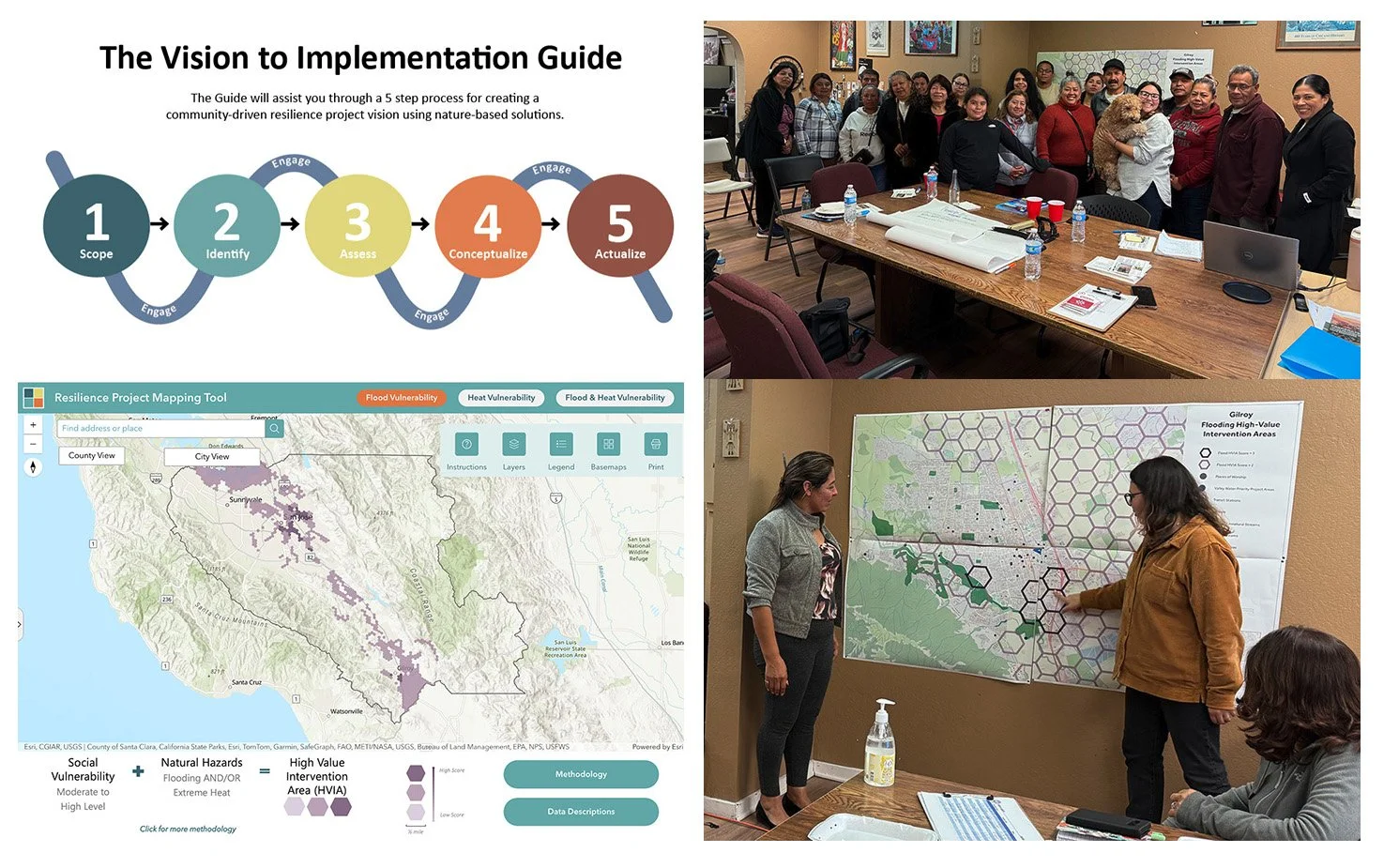
BRIEF — Bridging Climate Justice and Nature-Based Solutions: Santa Clara County’s Collaborative Approach to Heat and Flood Resilience What if you could map out where a community or government agency should invest in nature-based solutions at a neighborhood scale and systematically help to reknit the ecological system? What if those investments prioritized communities most vulnerable to climate hazards, reducing the risk of flooding and impacts from extreme heat? And what if you had a tool so simple to use that a layperson, a community-based organization, or a non-technical staff member could use it to help plan and advocate for those changes more effectively?
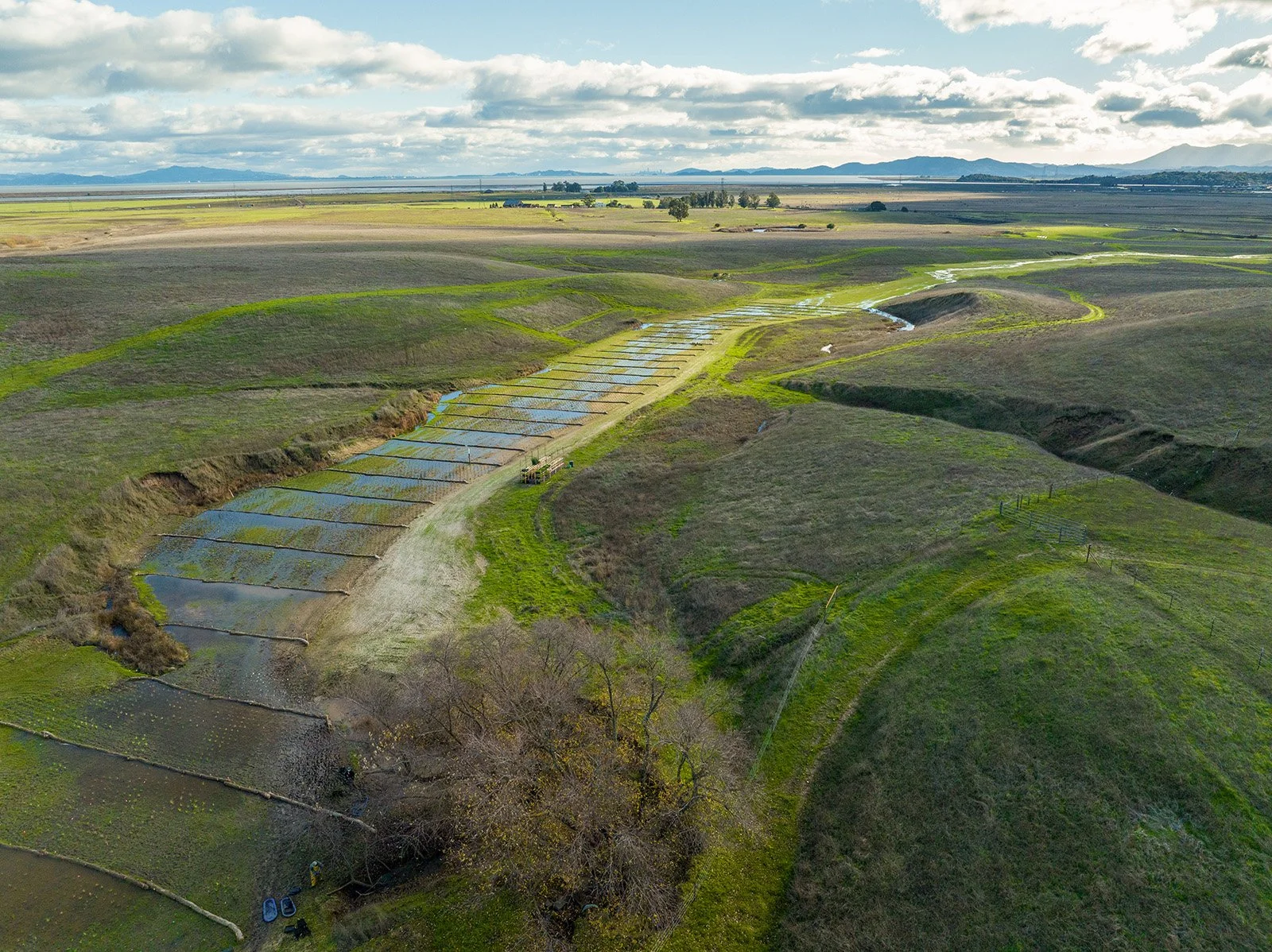
FEATURE — From Gully to Meadow: Stage Zero Restoration in the Bay Area In 2005, Sonoma Land Trust (SLT) acquired Sears Point Ranch, located at the southern tip of Sonoma County, with the aim of restoring its diverse collection of grasslands, ephemeral streams, and tidal wetlands spanning from ridge top to the bay. A decade later, after reuniting nearly 1,000 acres of diked agricultural baylands with the tides, we turned our attention to the degraded channels draining the steep, grassy hillslopes of the charismatic Cougar Mountain.
SLT began its freshwater work with the construction of three ponds in one of Sears Point Ranch’s ephemeral stream valleys to create habitat for California red-legged frog (Rana draytonii). After the ponds were completed, SLT shifted its focus to a deeply incised and degraded ditch on the preserve’s western edge which later came to be known as Lakeville Creek. We began a partnership with PCI Ecological, a local ecological consulting firm, to conceptualize restoration solutions.
Winter 2025/2026: Past, Present, and Moving Forward
A robust return of our beloved Ecesis News Journal, under the editorial leadership of Yamina Pressler
Here is a link to the full issue! OR you can browse via the images or the excerpts below.
A NOTE FROM THE PRESIDENT — PAST, PRESENT, AND MOVING FORWARD “…I invite each of you to help shape the future vision of SERCAL — to find your place within this organization and contribute your voice and perspective (in whatever way suits you) while growing alongside us. I also challenge you to seek ways to accelerate our restoration efforts while maintaining the highest standards of quality and integrity. Find ways to remove barriers, question the status quo, champion ecosystems and keep learning. Don’t be afraid to experiment and fail — just be sure to share your lessons learned so that we can all move forward together. Always remember the human communities that we work in and around and strive to find balance between development and ecological protection…”
A LETTER FROM THE EDITOR “...As a SERCAL community, our efforts are varied and impactful. One thing I have taken away from these stories is that we learn better together. This issue is full of examples of just that: from the ground swell of student leadership in the Davis Rewilding Society to the hands-on education of the Wildfire Resilience Program and River Stewards Program to the creative and collaborative efforts to restore shorelines, deltas, wildlife habitat, and riparian corridors. Your stories provide inspiration, calls to action, and a vision for a future of restoration in California that we can all work towards..."
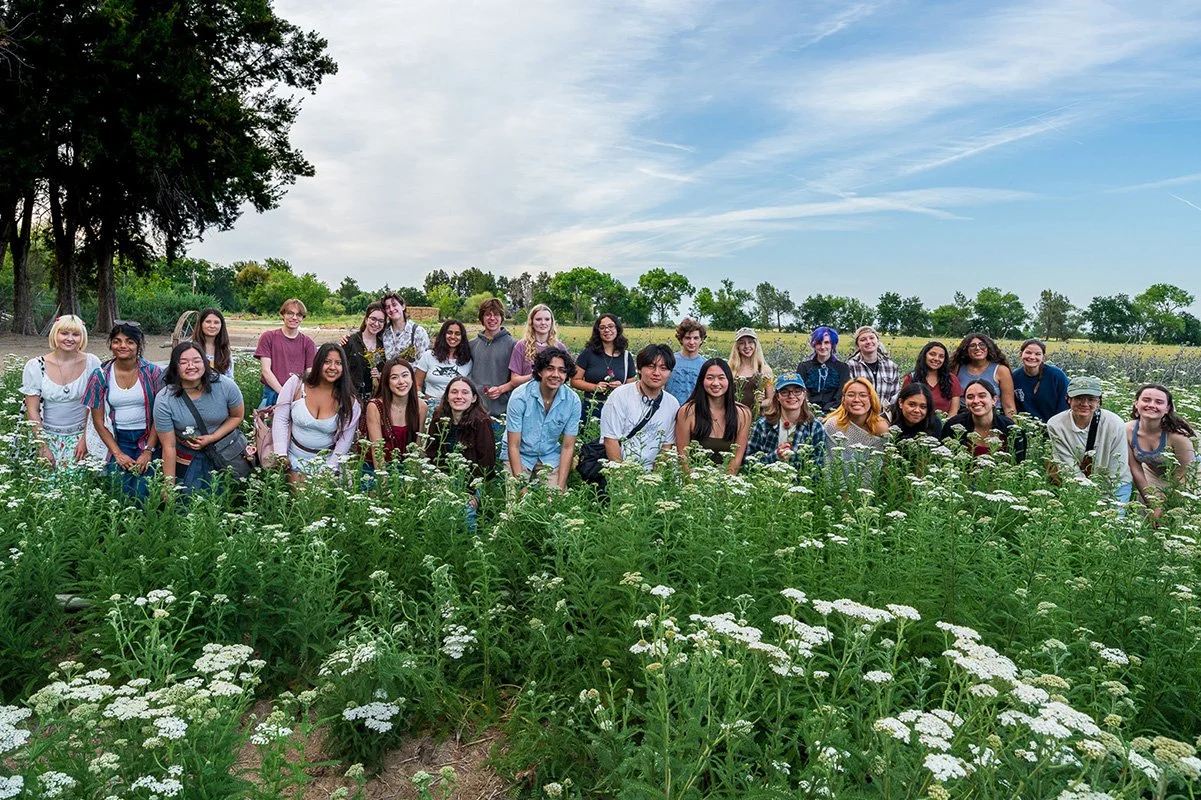
FEATURE — The Davis Rewilding Society: Student-Led Conservation, Restoration Education, and Empowerment In 2021, three University of California, Davis students emerging from COVID founded the Davis Rewilding Society to improve habitat for urban wildlife using native plants and foster community. With no funding, these three friends gathered wild native seed and hosted their first planting event with just three tools to go around the 25 students who showed up. What once started as a scrappy, passionate friend group has now expanded into an officer team of 11 and a network of over 2,000 undergraduate students…
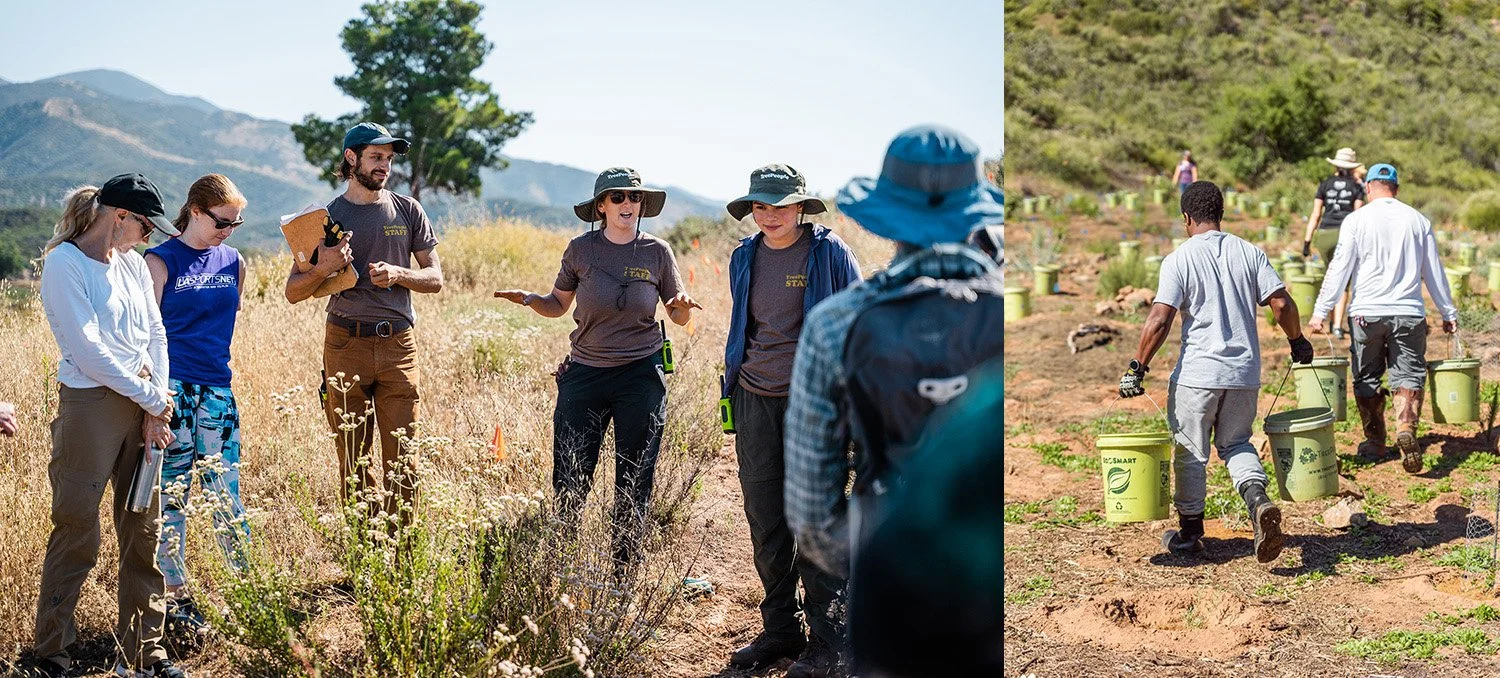
BRIEF — Successful High Diversity Chaparral Restoration in 2002 Copper Fire Scar In 2002, the Copper Fire burned approximately 20,000 acres of coastal sage scrub, chaparral, grasslands, and riparian corridor primarily in San Francisquito Canyon. In the wake of the fire, swaths of land gave way to type conversion, changing from mixed coastal sage scrub and chaparral to fields of invasive species. In 2018, TreePeople received the first in a series of grants to restore ecosystems impacted by the Copper Fire through partnerships built with the National Fish and Wildlife Foundation (NFWF) and the US Forest Service (USFS) within the Angeles National Forest...
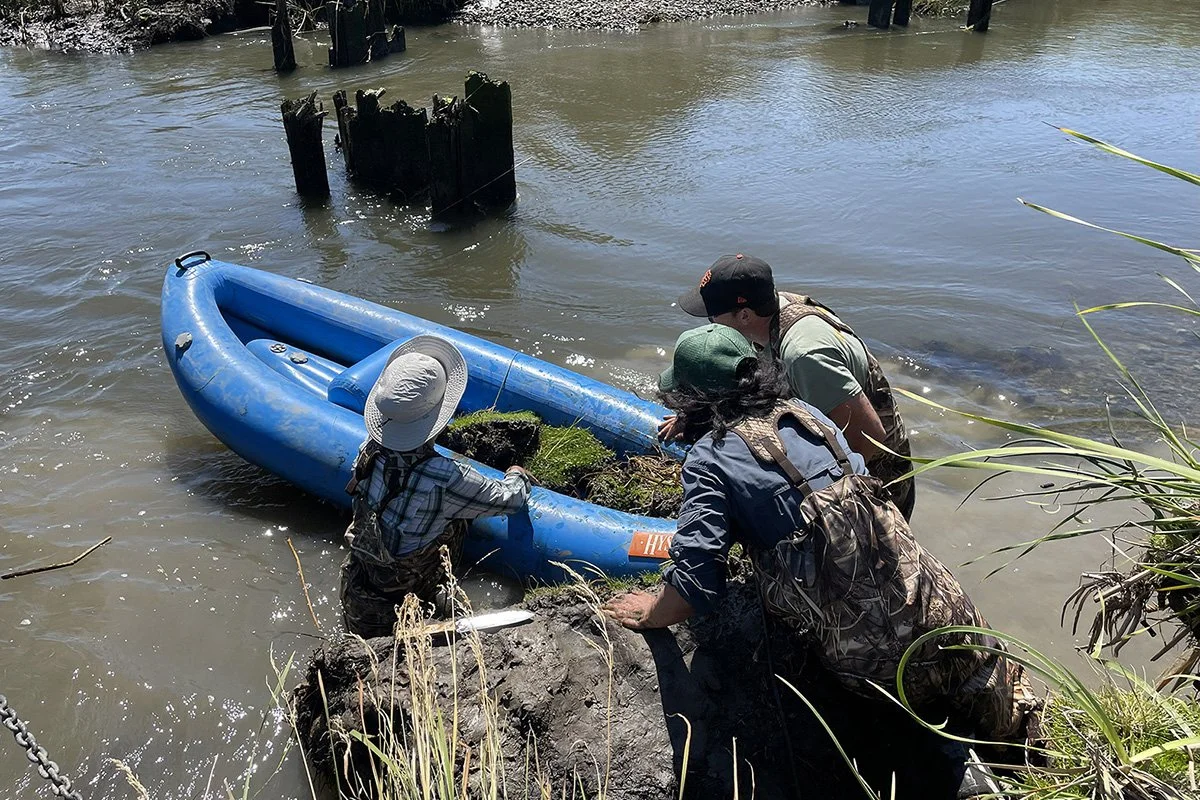
BRIEF — Rare plant mitigation in the San Francisco Bay Delta: Dozers and shovels and kayaks, oh my! …Loss of marsh habitat threatens numerous special-status plants (i.e., species identified as threatened or rare by the California Native Plant Society or the California or Federal Endangered Species Act) that rely on diverse Delta wetlands to thrive. However, many special-status plants have reinhabited portions of levees where slivers of their former habitat exist. Attempts to both rehabilitate failing levees and to restore tidal connectivity through excavated breaches have the potential to impact these plants...
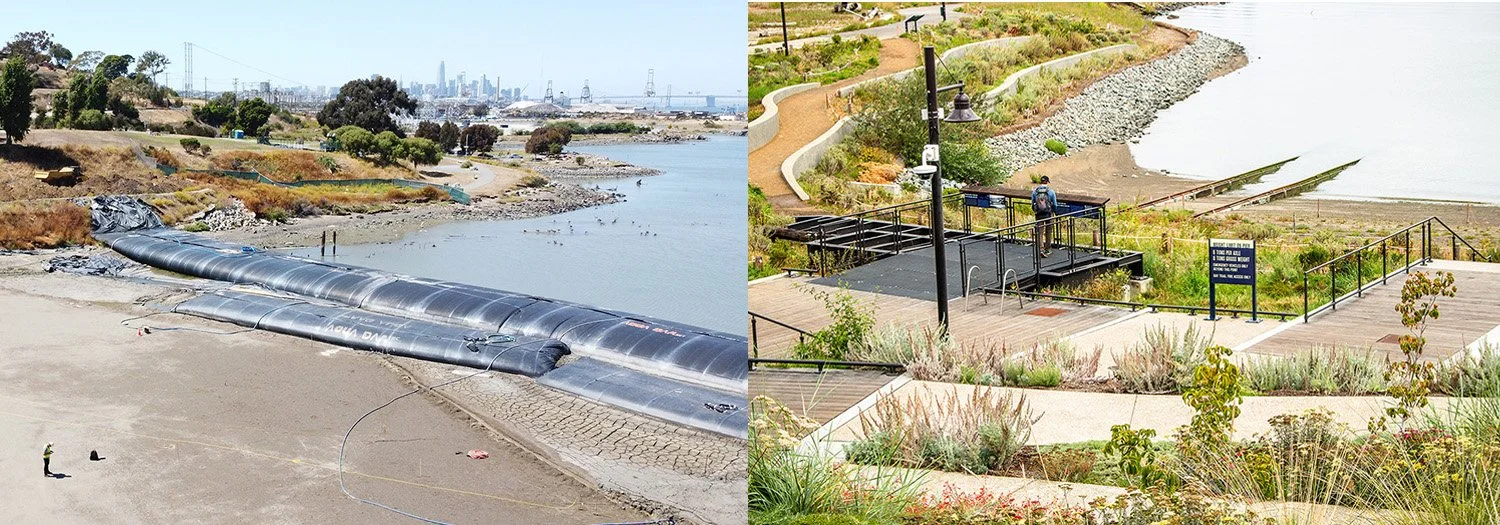
FEATURE — Restoring India Basin: Remediation, resiliency, and shoreline reconnection For over a century, the waterfront at India Basin in southeast San Francisco was a place of intensive industrial activity. Within this larger basin, the 900 Innes site once supported a bustling ship repair operation that over time evolved into an engineered shoreline of fill, creosote piles, paved surfaces, dilapidated buildings, damaged concrete wharves, and construction debris. Public access was limited. Today, this same stretch of shoreline is becoming one of the most significant park and habitat restoration projects in San Francisco’s history as the new India Basin Waterfront Park...
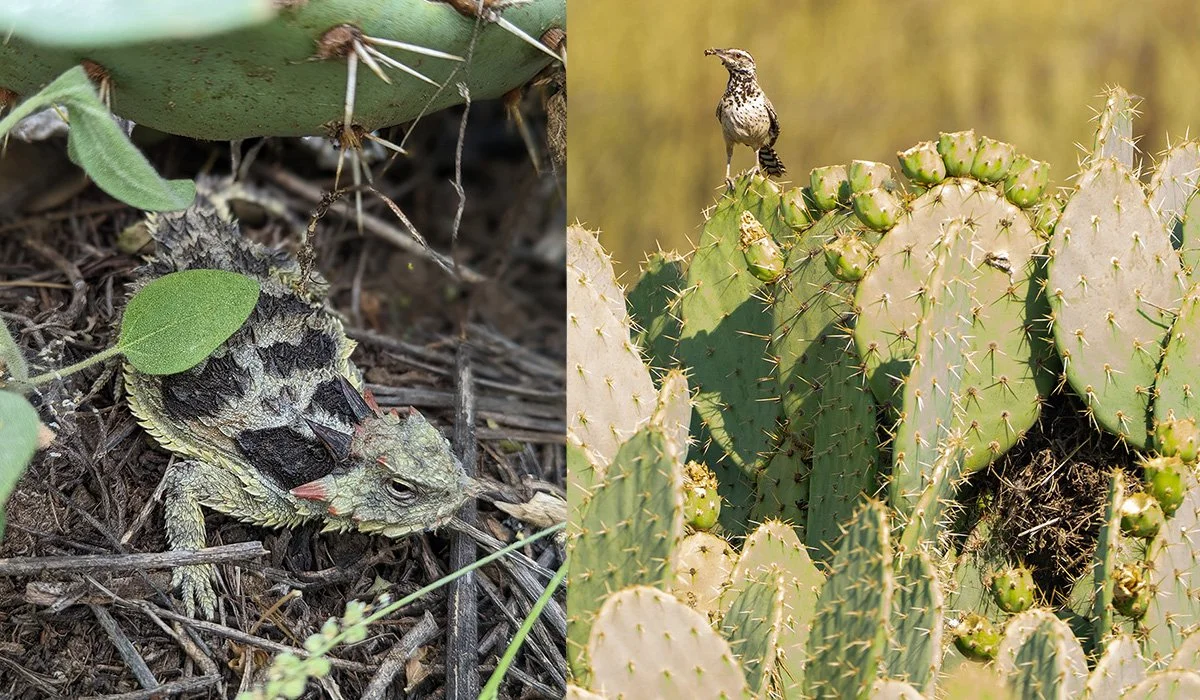
BRIEF — You Build It and They Will Come: The swift return of life to restored Coastal Cactus Wren habitat Restoration work often requires patience. Years can pass before ecological change is visible, and even then, nature may chart a different course than we imagined. That is why it has been particularly rewarding to witness a once-barren sand mine in Lakeside, San Diego County, begin its transformation into a thriving native cactus scrub ecosystem…
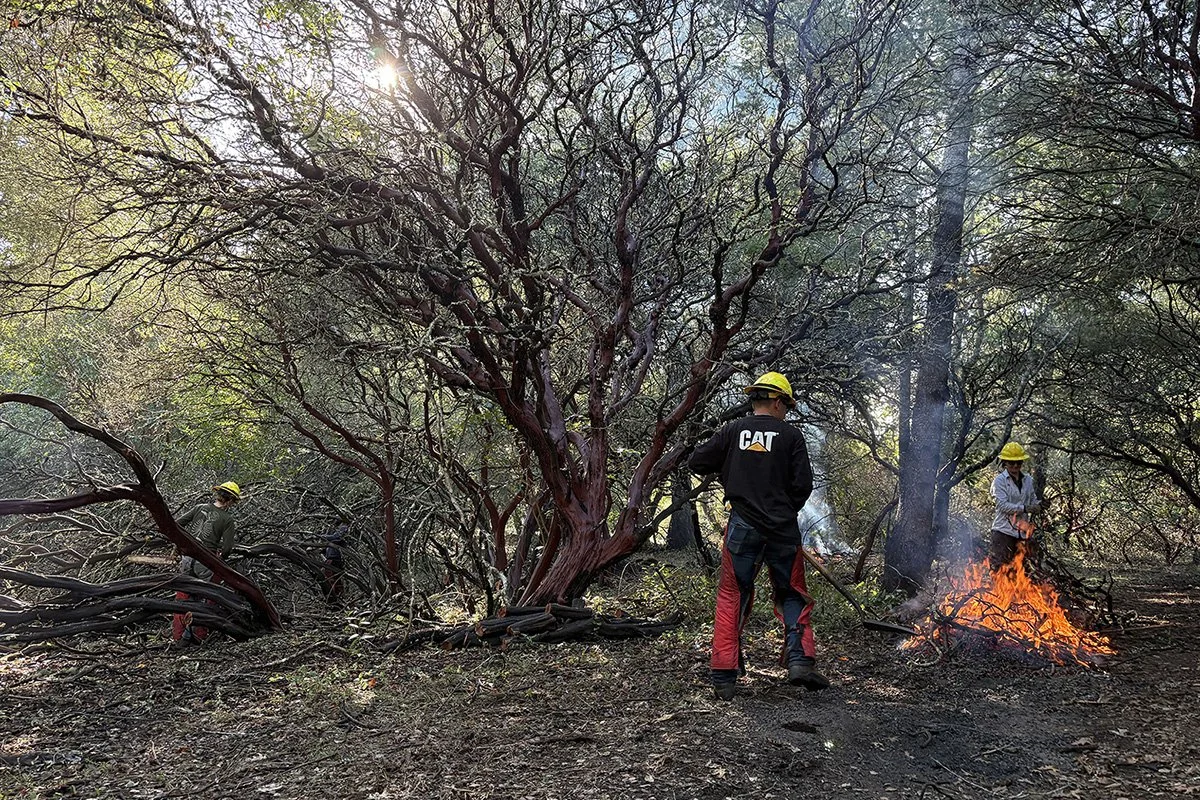
BRIEF — Chainsaws and Fire Teach Us to Listen to the Land: A workforce training program shaping the future of land stewards …Shone forest is home to the Wildfire Resilience Program (WRP), developed in 2021 with a grant from the county obtained through a PG&E settlement in direct response to the devastation caused by catastrophic wildfires. WRP is a workforce development program from which participants emerge with the skills and experience to enter the land stewardship profession. WRP offers paid internships, college credit, and a Wildfire Resilience certificate from the Natural Resource Management program…
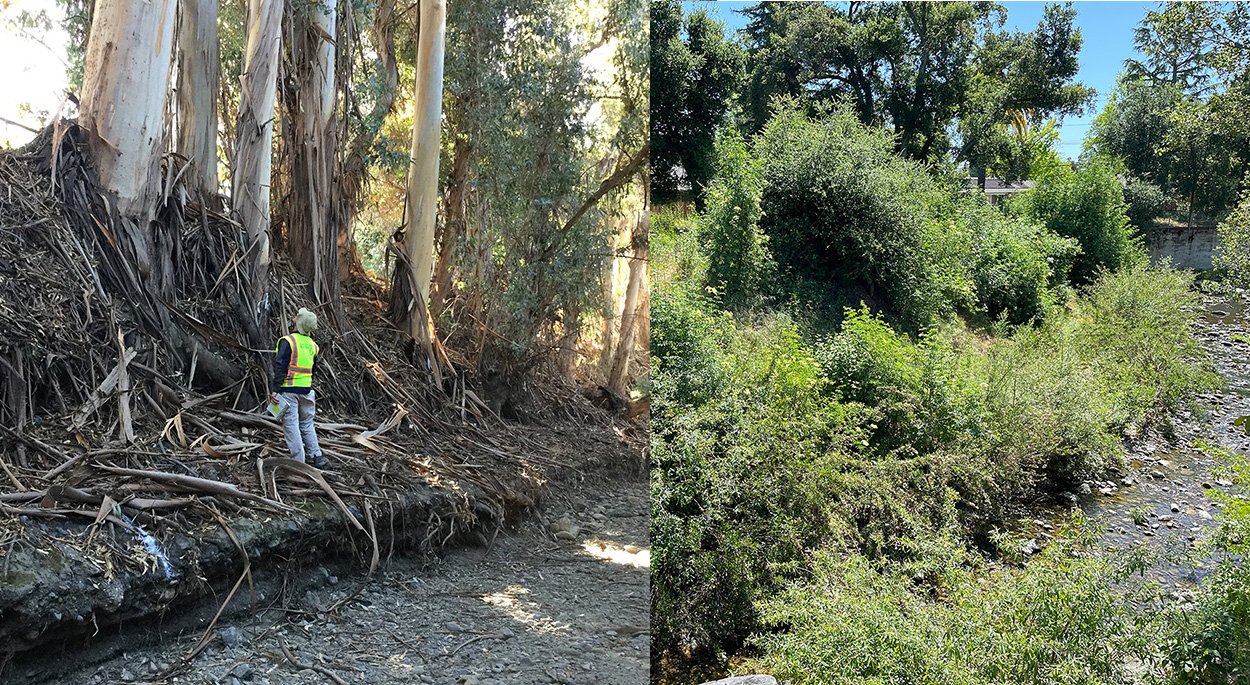
FEATURE — Saratoga Creek Hazard Tree Removal and Restoration Project: Large scale eucalyptus removal on a suburban creek in Silicon Valley …Valley Water manages 10 surface water reservoirs, 100 groundwater percolation ponds, three water treatment plants, a water quality laboratory, and more than 300 miles of streams and rivers (Valley Water 2025). The Saratoga Creek Hazard Tree Removal and Restoration Project is on Saratoga Creek in the City of Saratoga. The project goals are to remove hazardous invasive eucalyptus trees for public safety, enhance native and mixed riparian habitat, reduce the risk of bank erosion, and contribute to the regional understanding of post-eucalyptus restoration science…
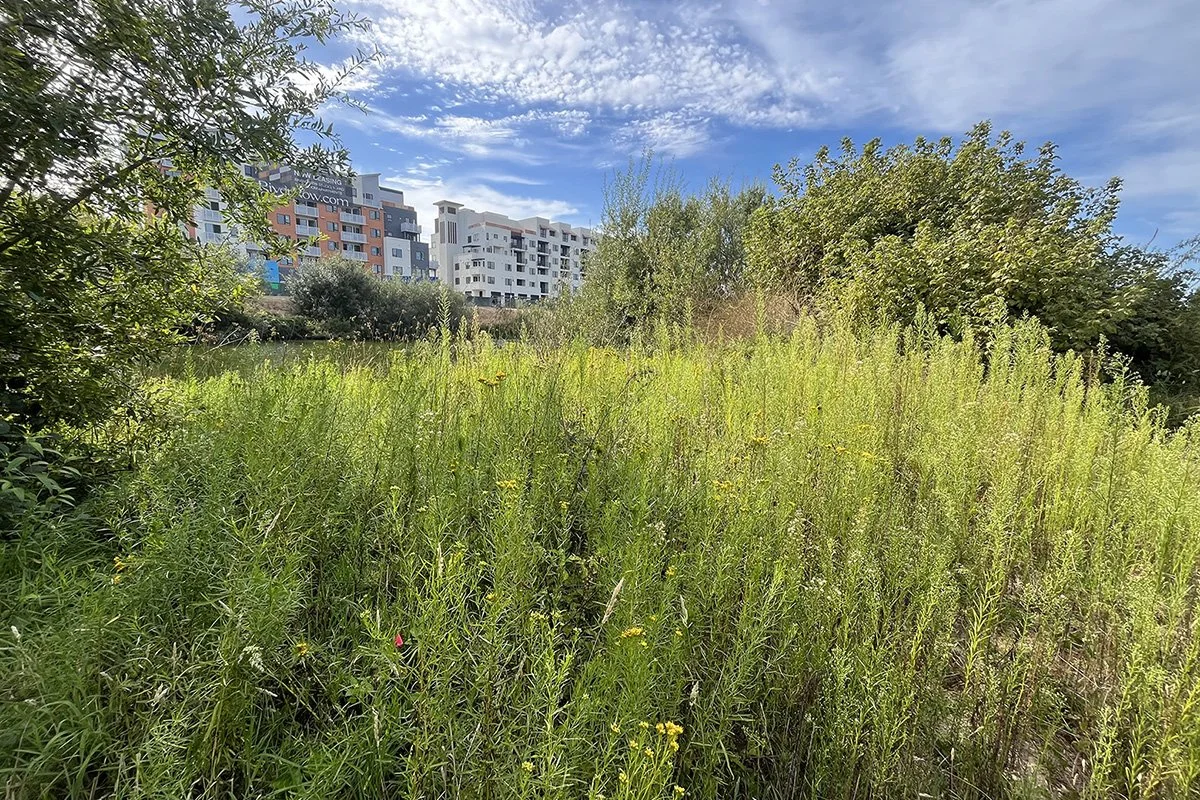
BRIEF — Healing Together: The interdependence between conservation and people experiencing homelessness …While people often refer to it as a “drainage ditch” and “void of life,” in reality the lower stretch of the San Lorenzo River serves as important habitat for many unique species; there are also many encampments and people experiencing homelessness. To help provide part of their path out of homelessness, the River Stewards Program engages unhoused individuals with environmental education, river stewardship, and outdoor experiences...
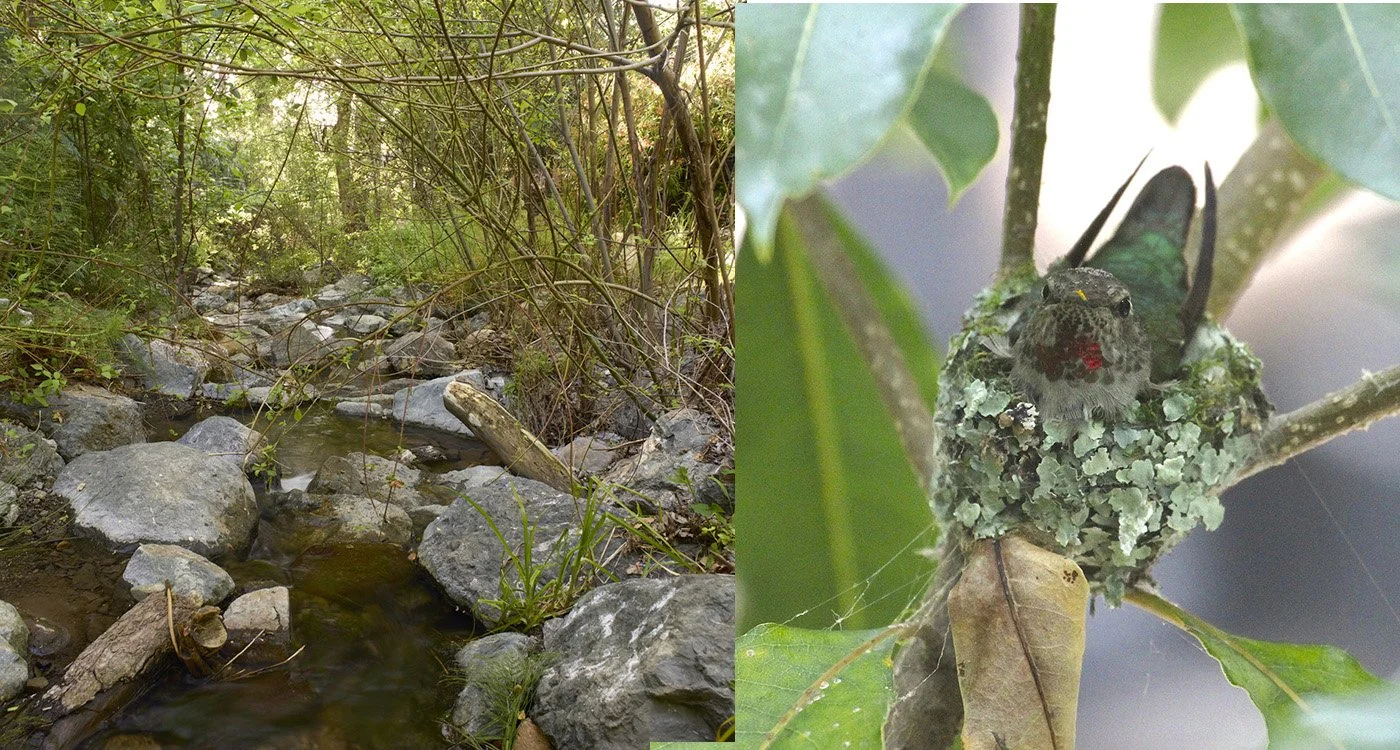
FEATURE — Yes in Our Backyards! A creek restoration showcase for urban biodiversity & resilience briefs This is a story about an urban creek, degraded by decades of short-sighted engineering decisions, that was brought back to health. Bringing nature back into our cities is essential not only for climate resilience, but also for generating support for biodiversity. Direct engagement can reconnect us to the natural world in our backyards and on our streets, to foster a deeper environmental ethic that spreads beyond city borders and across future generations…
IN SUMMARY — SERCAL 2025 Conference Field Safety Panel Recap The 2025 SERCAL conference in Sacramento included a panel discussion of field safety experiences and solutions. Trina Ming with Michael Baker International convened a diverse panel chosen based on their varied professional and academic backgrounds and level of experience to represent a wide range of perspectives from practitioners throughout the state…
IN SUMMARY — The Evolution of Public/Private Sector Partnerships for Building Locally Sourced Seed Industries Current restoration seed markets are already insufficient to supply a growing eclectic market. Post-wildfire restoration alone has overwhelmed the market. Further, due to climate change, urban transformation to drier landscapes in the arid west has become an existential issue. Until our agricultural sector can catch up on cultivation and expansion of inventories, we must rely on other approaches, including native seed collections from the wild...
Summer 2024: SERCAL 2024 Recap
Have we mentioned it was a superlative gathering? Here are some of the highlights…
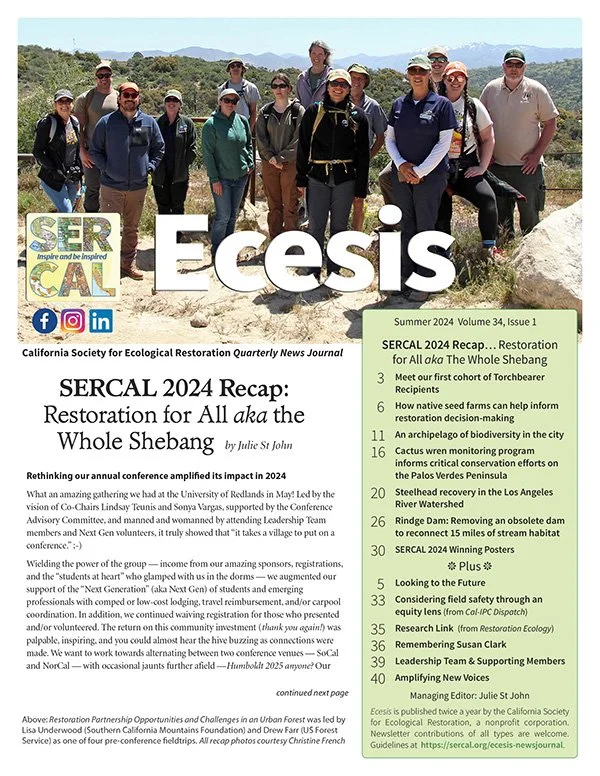
Click on image to download pdf.
How rethinking our annual conference amplified its impact in 2024
Meet our first cohort of Torchbearer Recipients
How native seed farms can help inform restoration decision-making
An archipelago of biodiversity in the city
Cactus wren monitoring program informs critical conservation efforts on the Palos Verdes Peninsula
Steelhead recovery in the Los Angeles River Watershed
Rindge Dam: Removing an obsolete dam to reconnect 15 miles of stream habitat
SERCAL 2024 Winning Posters
PLUS
Looking to the Future
Considering field safety through an equity lens (from Cal-IPC Dispatch)
Research Link (from Restoration Ecology)
Remembering Susan Clark
Leadership Team & Supporting Members
Amplifying New Voices
Spring into Summer 2023: Restoration With All
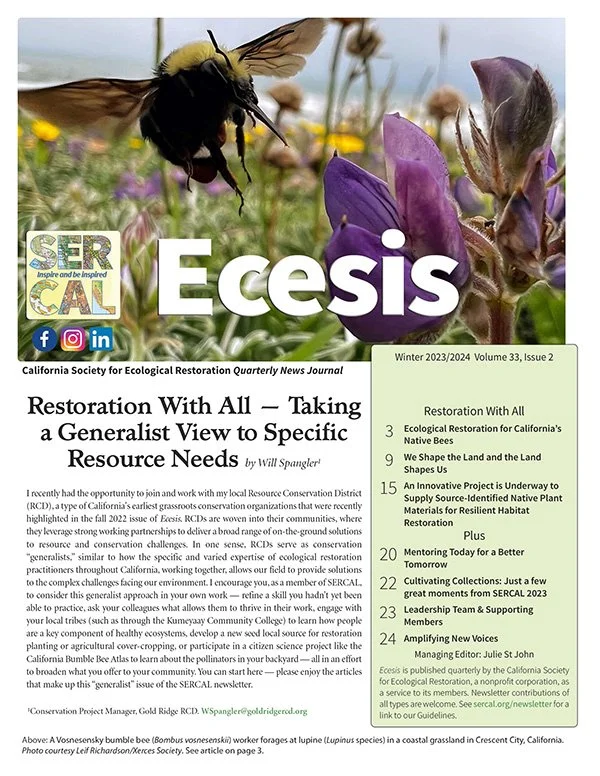
Click on image to download pdf.
Many thanks to Guest Editor Will Spangler (Gold Ridge Resource Conservation District) and all contributors for this inspiring issue!
INSIDE
Ecological Restoration for California’s Native Bees
We Shape the Land and the Land Shapes Us
An Innovative Project is Underway to Supply Source-Identified Native Plant Materials for Resilient Habitat Restoration
PLUS
Mentoring Today for a Better Tomorrow
Cultivating Collections: Just a few great moments from SERCAL 2023
Leadership Team & Supporting Members
Amplifying New Voices
Winter 2022/2023: Process-Based Restoration
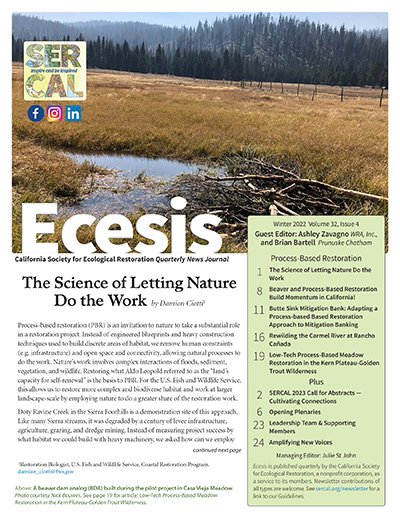
Click on image to download pdf.
Many thanks to Guest Editors Ashley Zavagno (WRA, Inc.) and Brian Bartell (Prunuske Chatham) and all contributors for this compelling issue!
INSIDE
The Science of Letting Nature Do the Work
Beaver and Process-Based Restoration Build Momentum in California!
Butte Sink Mitigation Bank: Adapting a Process-based Based Restoration Approach to Mitigation Banking
Rewilding the Carmel River at Rancho Cañada
Low-Tech Process-Based Meadow Restoration in the Kern Plateau-Golden Trout Wilderness
PLUS
SERCAL 2023 Call for Abstracts — Cultivating Connections
Opening Plenaries
Leadership Team & Supporting Members
Amplifying New Voices
Fall 2022: Special Issue of Resource Conservation Districts
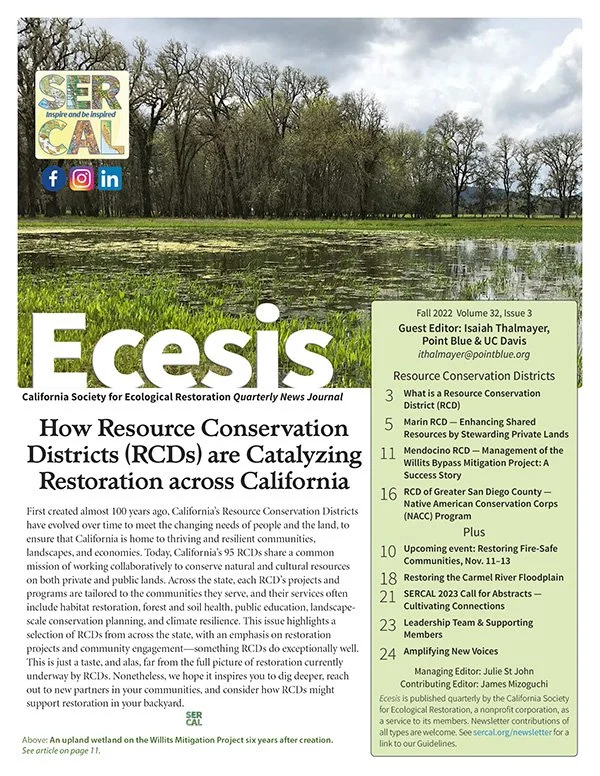
Many thanks to Guest Editor Isaiah Thalmayer (Point Blue and UC Davis) and all contributors for this illuminating issue!
INSIDE
What is a Resource Conservation District (RCD)
Marin RCD — Enhancing Shared Resources by Stewarding Private Lands
Mendocino RCD — Management of the Willits Bypass Mitigation Project: A Success Story
RCD of Greater San Diego County — Native American Conservation Corps (NACC) Program
PLUS
Upcoming event: Restoring Fire-Safe Communities, Nov. 11–13
Restoring the Carmel River Floodplain
SERCAL 2023 Call for Abstracts — Cultivating Connections
Leadership Team & Supporting Members
Amplifying New Voices
Summer 2022: Special Phytophthora Issue and So Much More!
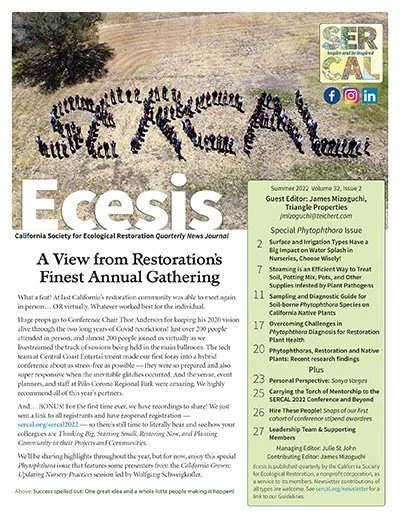
Here’s the latest version! (07/08/2022)
Many thanks to Guest Editor James Mizoguchi of Triangle Properties and all contributors for this enlightening issue!
INSIDE:
Surface and Irrigation Types Have a Big Impact on Water Splash in Nurseries, Choose Wisely!
Steaming is an Efficient Way to Treat Soil, Potting Mix, Pots, and Other Supplies Infested by Plant Pathogens
Sampling and Diagnostic Guide for Soil-borne Phytophthora Species on California Native Plants
Overcoming Challenges in Phytophthora Diagnosis for Restoration Plant Health
Phytophthoras, Restoration and Native Plants: Recent research findings
PLUS:
Personal Perspective: Sonya Vargas
Carrying the Torch of Mentorship to the SERCAL 2022 Conference and Beyond
Hire These People! Snaps of our first cohort of conference stipend awardees
Leadership Team & Supporting Members
Spring 2022: Restoration through the Eyes of our Non-profit Partners

Many thanks to Guest Editor Geoff Smick of WRA, Inc., and all contributors for this informative issue on nonprofits partners…
INSIDE:
Pepperwood: A Living Laboratory for Climate Adaptation in California’s Coast Ranges
The Ecological Workforce Initiative
Restoration Overview on The Wildlands Conservancy’s Sonoma Coast Preserves
Partnership-Driven Post-Fire Restoration in the San Gabriel Mountains
From Grass Roots to Native Roots — A Case Study in Urban Restoration and Community Partnership
PLUS:
SERCAL Annual Update
Diversity & Inclusion Conversations, Volume 1.2

Many thanks to the contributors of this issue — a roundup of some of the most popular presentations at SERCAL 2021.
INSIDE:
Increasing the Diversity of People and Ecosystems through Restoration
Bringing Habitat Home through Leadership and Mentorship
Restoration and Cultural Fire
PLUS:
Leadership Team & Supporting Members

Many thanks to Guest Editor Will Spangler of Santa Clara Valley Habitat Agency and all contributors for this informative issue on sycamores…
INSIDE:
California Sycamore Hybridization with a Common Landscaping Tree and Implications for Restoration of Riparian Habitat
Native Sycamore Propagation: A Collaborative Research Study
PLUS:
SERCAL 2021 Jobs & Networking Panel Recap
Mattole Field Institute: Fertile Ground for Field-Based Learning
Post-Fire Seeding & Mitigation on the Butte Fire
Mentoring the Next Generation
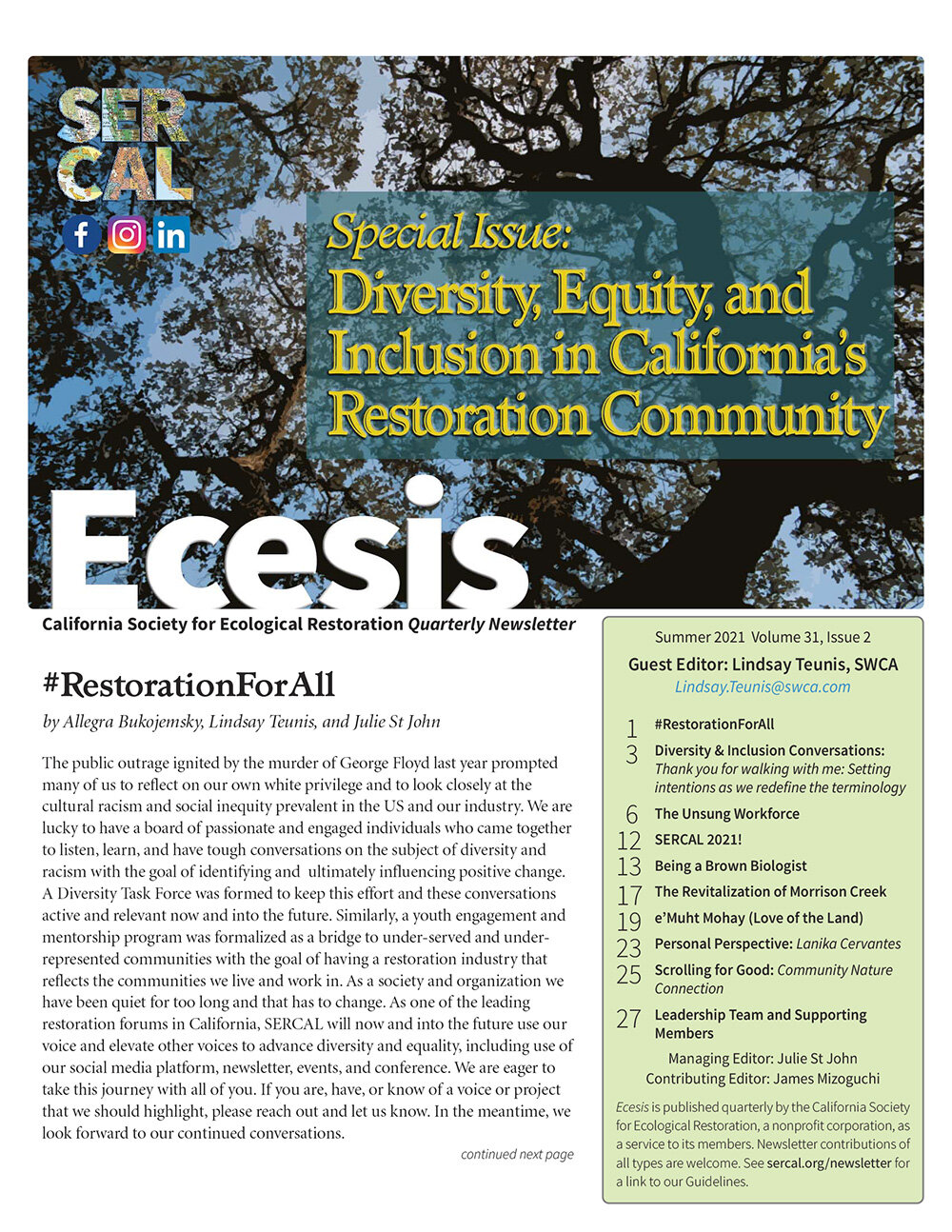
Summer 2021: Diversity, Equity, and Inclusion in California’s Restoration Community
Many thanks to Guest Editor Lindsay Teunis of SWCA and all contributors for this inspiring issue!
INSIDE:
#RestorationForAll
Diversity & Inclusion Conversation (new, regularly occurring feature)
The Unsung Workforce
Being a Brown Biologist
The Revitalization of Morrison Creek
e’Muht Mohay (Love of the Land)
Personal Perspective (new, regularly occurring feature)
Scrolling for Good (new, regularly occurring feature)
2021: Springing into Dam Removal!
Many thanks to Guest Editor Ross Taylor of Ross Taylor & Associates for shepherding this issue!
INSIDE:

Dam Removal as a Watershed Restoration Action
SERCAL 2021 Virtual Conference Sep 13–17: Call for Abstracts through May 15
Annual Sponsors Rise to the Challenge!
Removing Upper York Creek Dam and a Century of Steelhead Habitat Damage
Klamath Dam Removal Update — What’s Going On?
Habitat Blocked by Scott Dam in the Headwaters of the Mainstem Eel River: Is it enough to aid in recovery of steelhead trout and Chinook salmon populations?
2020
Turning the Corner on the Largest Delta Wetland Restoration Project to Date… and more! | Spring 2020
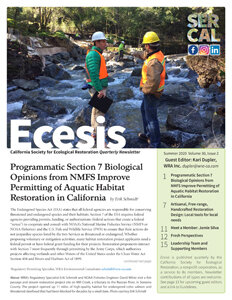
Programmatic Section 7 Biological Opinions from NMFS Improve Permitting Process… and more! | Summer 2020
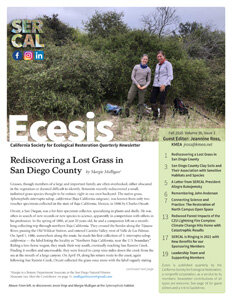
Rediscovering a Lost Grass in San Diego County… and more! | Fall 2020
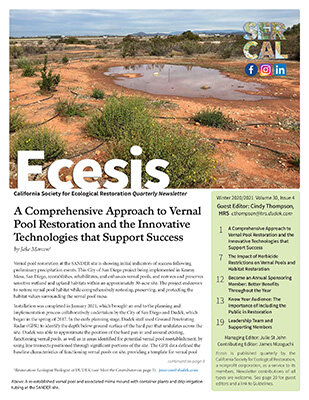
A Comprehensive and Innovative Approach to Vernal Pool Restoration… and more! | Winter 2020/2021
2019
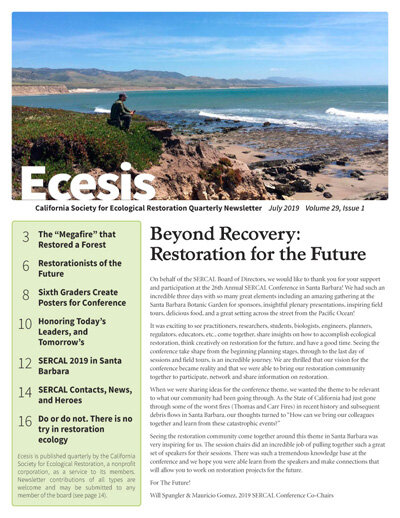
Beyond Recovery: Restoration for the Future | Spring into Summer 2019
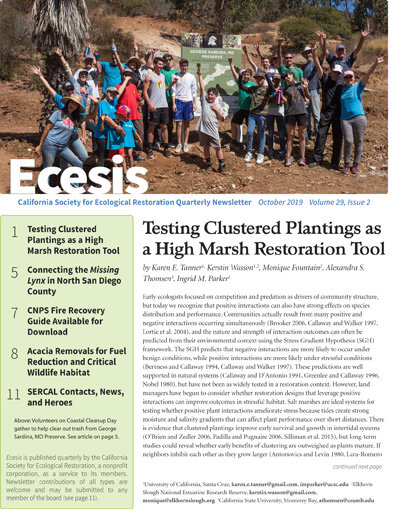
Testing Clustered Plantings as a High Marsh Restoration Tool... and more! | Fall 2019
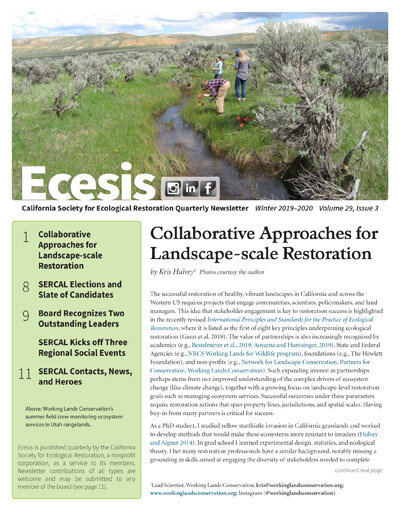
Collaborative Approaches for Landscape-scale Restoration | Winter 2019/2020
There is no 4th issue of Ecesis for 2019. :-(
2018
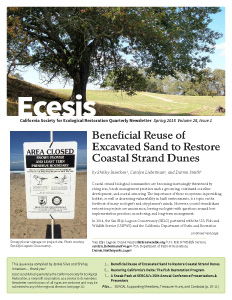
Restoring Coastal Strand Dunes, Restoring California’s Delta | Spring 2018
SERCAL 2018 Highlights | Summer 2018
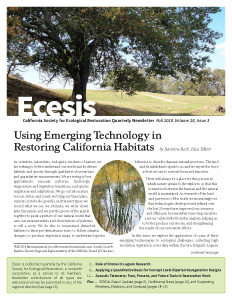
Using Emerging Technology | Fall 2018
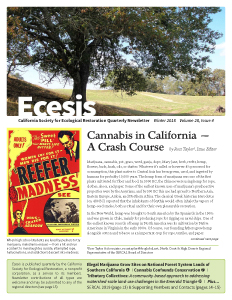
Cannabis in California | Winter 2018
2017
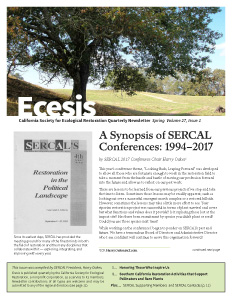
A Synopsis of SERCAL Conferences: 1994–2017 | Spring 2017
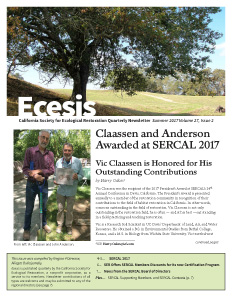
Claassen and Anderson Awarded at SERCAL 2017 | Summer 2017
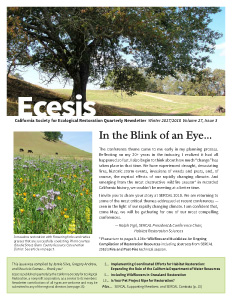
In the Blink of an Eye | Fall–Winter 2017
There is no 4th issue of Ecesis for 2017. :-(
2016
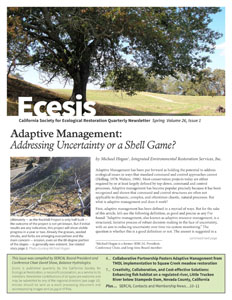
Adaptive Management: Addressing Uncertainty or a Shell Game? | Spring 2016
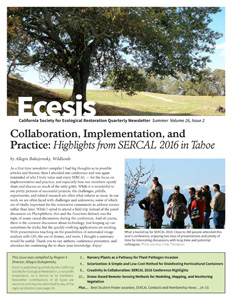
Collaboration, Implementation, and Practice: Highlights from SERCAL 2016 in Tahoe | Summer 2016
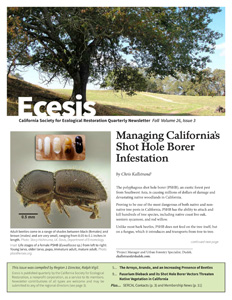
Managing California's Shot-hole Borer Infestation | Fall 2016
The Use of Passive and Active Approaches in Restoration Projects | Winter 2016
2015
Teaming with an Urban Community to Take Back a Watershed | Spring 2015
Benefits of Tidal and Estuary Restoration | Summer 2015
New Challenges and Opportunities for Developing Restoration Plant and Seed Palettes | Fall 2015
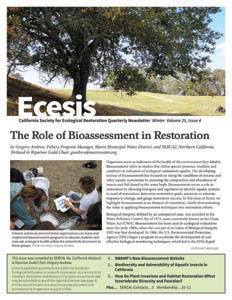
The Role of Bioassessment in Restoration | Winter 2015
2014
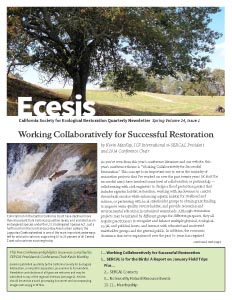
Working Collaboratively for Successful Restoration | Spring 2014
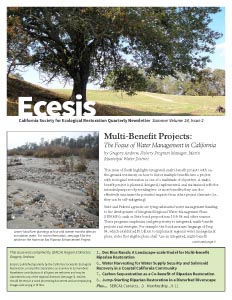
Multi-Benefit Projects: The Focus of Water Management in California | Summer 2014
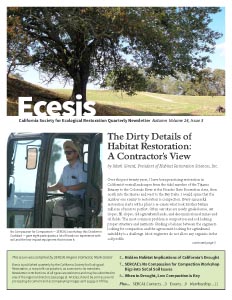
The Dirty Details of Habitat Restoration: A Contractor's View | Fall 2014
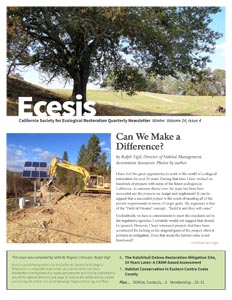
Can We Make a Difference? | Winter 2014
2013
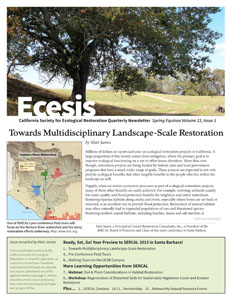
Towards Multidisciplinary Landscape-Scale Restoration | Spring 2013
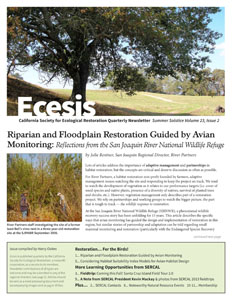
Riparian and Floodplain Restoration Guided by Avian Monitoring | Summer 2013
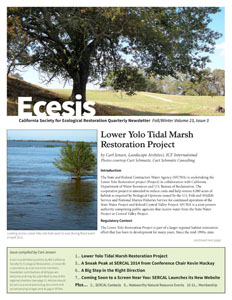
Lower Yolo Tidal Marsh Restoration Project | Fall 2013
There is no 4th issue of Ecesis for 2013. :-(